
Race, Ethnicity and Breast Cancer Risk
Rates of breast cancer in the U.S. vary by race and ethnicity.
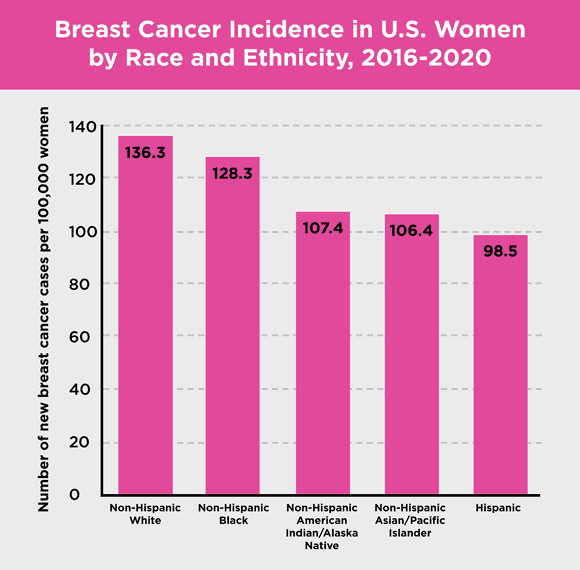
Non-Hispanic white women and non-Hispanic Black women have the highest incidence of breast cancer (rate of new breast cancer cases) overall [324]. Hispanic women have the lowest incidence (see Figure 2.3 below) [324].
Figure 2.3
|
| Source: 2016-2020 SEER data, 2023 [324] |
Learn about differences in breast cancer rates in the U.S. and around the world.
Lifetime risk of breast cancer by race and ethnicity
The lifetime risk of breast cancer for women in the U.S. is about 13% [5]. However, this risk varies by race and ethnic group.
Race and ethnicity |
Lifetime risk of breast cancer |
Non-Hispanic White |
14% |
Non-Hispanic Black |
12% |
Non-Hispanic Asian and Pacific Islander |
12% |
Hispanic |
11% |
Non-Hispanic American Indian and Alaska Native |
10% |
Source: 2017-2019 SEER data, 2023 [325] |
|
Why are there differences in breast cancer rates?
One reason behind differences in breast cancer rates may be that the prevalence of some risk factors for breast cancer vary by race and ethnic group [13]. This means some risk factors are more common in women of some racial and ethnic groups than in other women.
Known risk factors that vary by race and ethnicity include [326-335]:
- Age at first period
- Age at menopause
- Age at first childbirth
- Body weight
- Breastfeeding
- Number of childbirths
- Menopausal hormone therapy (postmenopausal hormone use, hormone replacement therapy (HRT))
For example, studies show white women are more likely than women of some other ethnicities (including Black and Hispanic women) to have children at a later age, to have fewer children and to use menopausal hormone therapy [13,328-329,333,335]. These factors are linked to an increased risk of breast cancer [13].
Learn more about rates of breast cancer by race and ethnicity.
Learn about race, ethnicity and breast cancer screening.
Black women
Overall, Black women have similar rates of breast cancer as white women[324].
However, there are differences by age [336]:
- Among younger women, Black and non-Hispanic Black women have higher rates of breast cancer compared to white and non-Hispanic white women.
- Among older women, white and non-Hispanic white women have higher rates of breast cancer compared to Black and non-Hispanic Black women.
For example, in 2020 (most recent data available), among women ages 15-39, the incidence of breast cancer in Black women was 25 per 100,000 women and the incidence of breast cancer in white women was 22 per 100,000 women [337].
The reasons behind these differences are under study. They may include some risk factors that are more common in women of some racial and ethnic groups than in other women as well as differences in tumor biology [326-335].
Age at diagnosis
Black women tend to be diagnosed with breast cancer at a younger age than white women [7].
From 2016-2020 (most recent data available), the median age at breast cancer diagnosis for Black women was 60, compared to 64 for white women [7].
Learn about Komen’s commitment to health equity.
Learn more about breast cancer in Black women.
Triple negative breast cancer (TNBC)
Incidence rates (new cases per year) of triple negative breast cancer (TNBC) differ by race and ethnicity.
TNBC is:
- Estrogen receptor-negative (ER-negative)
- Progesterone receptor-negative (PR-negative)
- HER2-negative
TNBC is more common among Black and African American women than among women of other ethnicities [332,338-341]. TNBC may also be more common among Hispanic women compared to white and non-Hispanic white women [342-344].
TNBC is often aggressive. Early TNBC is more likely than estrogen receptor-positive breast cancers to recur, at least within the first 5 years after diagnosis [341,345].
After about 5 years, the risk of TNBC recurrence is low [341,345].
Possible reasons for differences in rates of TNBC
Although the reasons for racial and ethnic differences in rates of TNBC aren’t clear, some factors may play a role [346].
Compared to white and non-Hispanic white women, studies show Black and African American women tend to [123-124,329,346-348]:
- Have lower rates of breastfeeding
- Carry excess weight in the abdomen area
Each of these factors is linked to a small increased risk of TNBC [123-124,329,346-348].
Women with certain reproductive and lifestyle factors may have a lower risk of estrogen receptor-positive breast cancers, but not a lower risk of estrogen receptor-negative breast cancers, including TNBC [75-76,80-81,123,329,335,343,349].
Black and African American women may be more likely than white women to have risk factors linked more to a lower risk of estrogen receptor-positive cancers than to a lower risk of TNBC [75-76,80-81,123,329,335,343,349].
For example, non-Hispanic Black, African American, Hispanic and Latina women are more likely than white women to [123,329,335,343,347-349]:
- Have more children
- Be a younger age at first childbirth
- Be overweight or obese before menopause
Although these factors are linked to a lower risk of breast cancer, this lower risk may be limited to estrogen receptor-positive breast cancers [75-76,80-81,123,329,335,343,349].
There’s even some evidence these factors may be linked to an increased risk of TNBC [75-76,80-81,123,329,347].
These topics are under study.
Learn more about rates of breast cancer by race and ethnicity.
Learn more about the molecular subtypes of breast cancer.
Updated 04/26/24
