
Breast Cancer Risk Factors: Breast Density on a Mammogram
What is breast density?
Breast density is a measure used to describe mammogram images. It’s not a measure of how the breasts feel.
Breasts are made up of breast tissue (the milk ducts and lobules, which may be called glandular tissue) and fat. Connective tissue helps hold everything place. Learn more about breast anatomy.
Breast density compares the area of breast and connective tissue seen on a mammogram to the area of fat. Breast and connective tissue are denser than fat and this difference shows up on a mammogram (see images below).
- High breast density means there’s more breast and connective tissue compared to fat.
- Low breast density means there’s more fat compared to breast and connective tissue.
By looking at your mammogram or the measure of breast density, your health care provider may conclude you have dense breasts.
Learn about other factors linked to the risk of breast cancer.
How does dense breast tissue look on a mammogram?
The mammogram images below show a range of breast density. Some breasts are mostly fat (fatty breasts), and some breasts are mostly breast and connective tissue (dense breasts).
Mammograms of dense breasts are harder to read than mammograms of fatty breasts. This may make some abnormal findings harder to see on a mammogram.
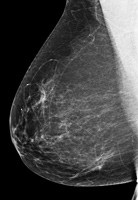 |
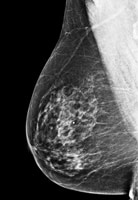 |
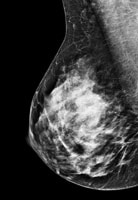 |
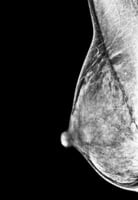 |
| Fatty breast | Some breast density | Dense breast | Very dense breast |
Images used with permission of the American College of Radiology (www.acr.org). |
|||
Learn more about breast density and mammography.
Breast density and breast cancer risk
Women with very dense breasts are 4-5 times more likely to get breast cancer than women with fatty breasts [112-113].
However, breast density does not appear to be related to breast cancer survival [114-116].
What affects breast density?
High breast density is common. In the U.S., 40%-50% of women ages 40-74 have dense breasts [117-118].
Breast density varies greatly by age and weight. Dense breasts are more common in both young women and lean women [117-118]:
- About 50% to 60% of women ages 40-44 have dense breasts, compared to 20% to 30% of women ages 70-74.
- About 50% to 60% of women with a healthy weight have dense breasts, compared to 20% to 30% of obese women.
Medications that contain hormones can also affect breast density. For example [119]:
- Women who take menopausal hormone therapy (MHT) tend to have denser breasts than they would if they didn’t take MHT. As women age, their breasts may become less dense and more fatty. Taking MHT slows this process. MHT may also be called postmenopausal hormone therapy or hormone replacement therapy (HRT).
- Women who take the drug tamoxifen (for breast cancer treatment or for breast cancer risk reduction) tend to have lower breast density than they would if they didn’t take tamoxifen.
Learn about other factors linked to the risk of breast cancer.
Screening for women with dense breasts
Dense breast tissue can make abnormal findings harder to see on a mammogram. Screening tools for women with dense breasts are under study.
There are no special recommendations or screening guidelines for women with dense breasts. However, your health care provider may suggest other types of breast imaging in addition to regular mammograms.
Learn more about breast cancer screening.
Breast density legislation
Many states in the U.S. have laws requiring health care providers to notify (send a letter to) women found to have dense breasts on a mammogram.
In March 2023, the Food and Drug Administration (FDA) updated their regulations to require all mammography centers in the U.S. to notify women about their breast density after getting a mammogram.
Although this may seem helpful, there are no special recommendations or screening guidelines for women with dense breasts. However, your health care provider may suggest other types of breast imaging in addition to regular mammograms.
Although women with dense breasts have an increased risk of breast cancer, it’s not clear that lowering breast density would be related to a decrease in risk. For example, getting older and gaining weight after menopause are both related to a decrease in breast density, but an increase in breast cancer risk.
If you have any concerns about your breast density or your risk of breast cancer, talk with your health care provider.
Updated 04/24/24
